
Instead of a charter trip, or a trip on the Island Packet we just purchased, this is a delivery trip that I crewed on. I had mentioned to Captain Jeremy (whom we hired for the last trip to help us move our Island Packet south) that I was looking to continue to get more experience, so he said he would let me know if he could use an extra crew on a trip. Jeremy reached out to me about a trip that he and his first mate Brian would be doing to deliver a boat from Dominican Republic to Marathon in the Florida Keys. This was a 2010 Beneteau 43.3 Cyclades made for Moorings that was in charter. Someone had recently bought the boat and was having it delivered to Florida. The timing for the trip was right after Christmas and I would be able to take advantage of a couple of holidays and not use too much vacation so that was convenient. Corrie and I were also already in Florida so I was able to drive over rather than have to fly to meet up with Jeremy and Brian.
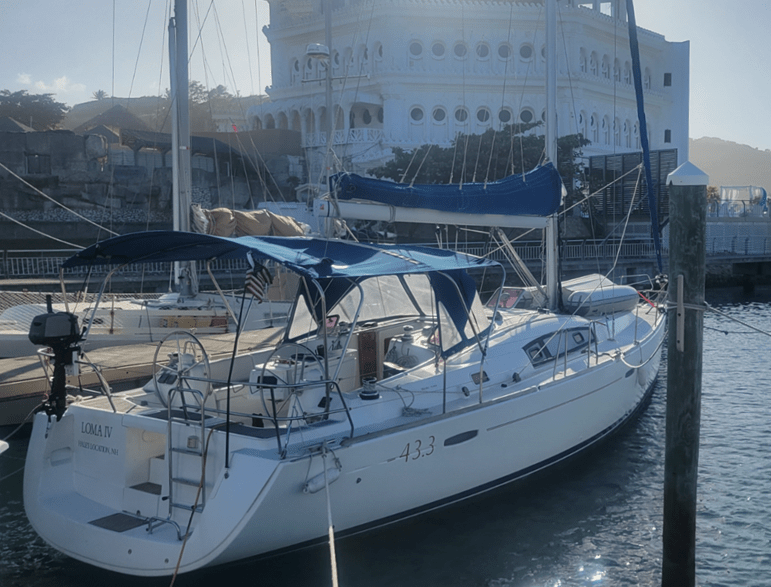
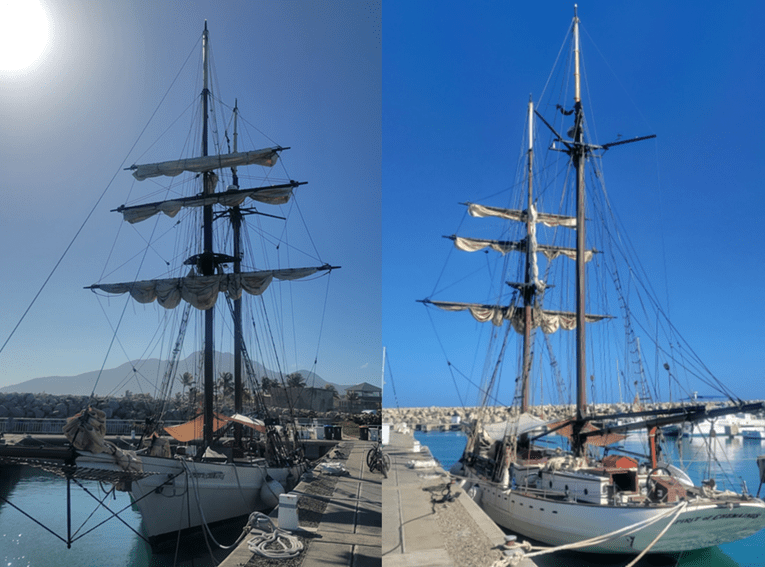
This turned out to be a different adventure than expected but I still learned a lot in the process. On Tuesday, December 27th, we flew out of Miami to Puerto Plata on the northern side of Dominican Republic and got a taxi to Ocean World Marina where the boat was. When we arrived, we found that the bilge pump had been running constantly due to a stuck float switch and the pump was very hot to the touch. There was a spare pump on board and we were able to get a spare float switch to replace the bilge pump. There were very minimal tools onboard to work with but we were able to get some key items such as a multi-meter from other cruisers that were there. We found there were some other issues on the boat as well. The house battery bank would not hold a charge well. There were 3 heads (toilets) but only one worked. The bottom of the boat had a lot of growth since it had not been cleaned in awhile and this slows the speed that we could sail. We arrived too late in the day to provision and head out so we relaxed with some of the local sailors that evening. One of the sailors has an antique 90 foot brigantine sailboat that he and his family sailed across the Atlantic. Imagine maneuvering through a marina with that 20’ bowsprit! He’s also a naval engineer and showed us the Open 40 racing sailboat that a race commissioned him to build. There were a number of other long term cruisers there and talking to them makes me realize what is possible for Corrie and I on our cruising boat.

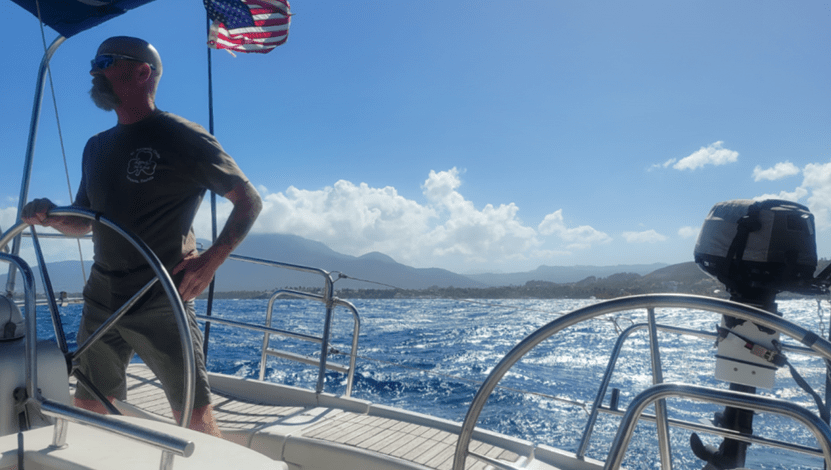
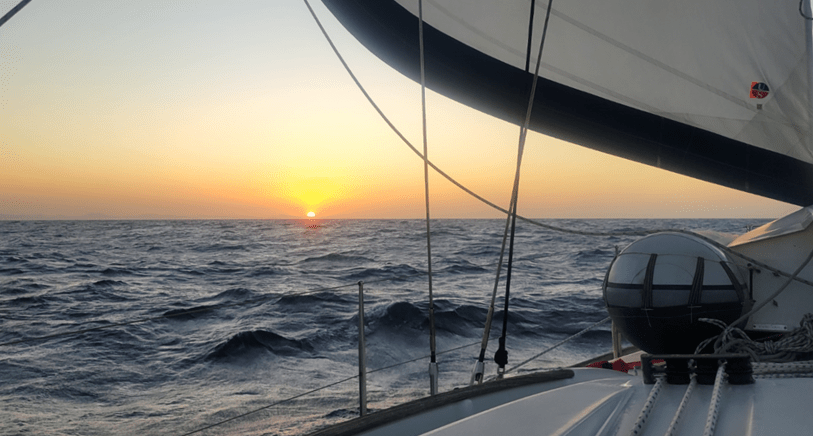
After provisioning, fueling up, and clearing out of customs/immigration, we left the harbor at 2pm on Wednesday, the 28th. We had east winds of 12-20 knots apparent and 6 foot following seas pushing us west. We would occasionally get sets of larger waves that the boat would surf down. We were on a very broad reach (almost running downwind) with full headsail up. That gave us plenty of power and so we did not need to hoist the mainsail. We were traveling at 5 – 7.5 knots depending on the wind level.
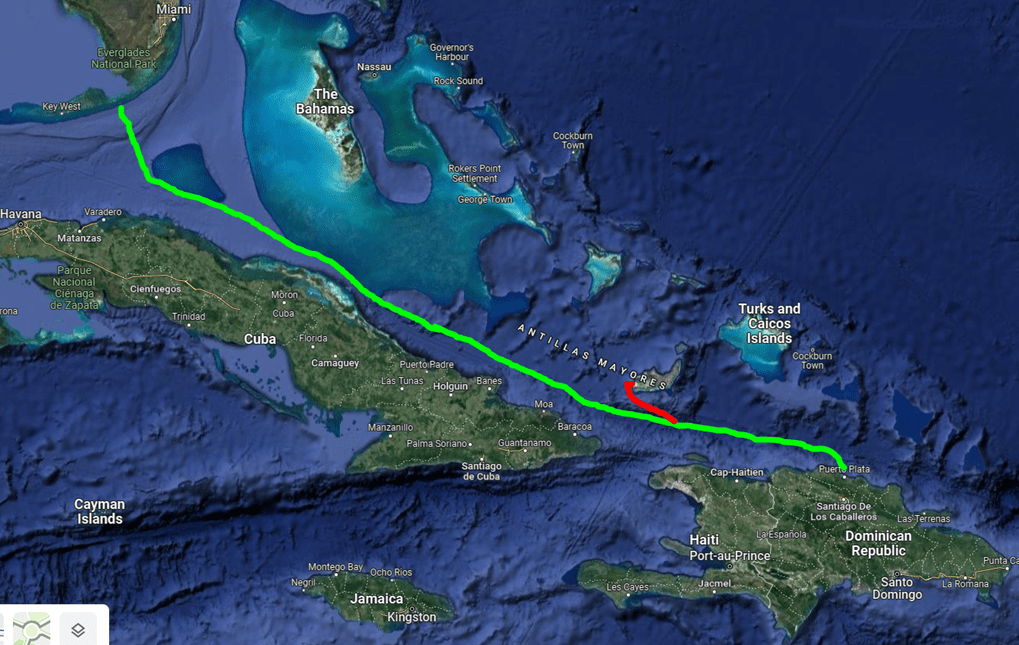
Our plan was to go west through the Old Bahama Channel just north of Cuba and then head northwest across the Gulf Stream to reach the Florida Keys. We had good winds forecasted through several days until the wind was forecasted to drop when we reached the Gulf Stream which would be good since opposing wind and current make for rough seas. During the day, typically 2 or 3 of us would be in the cockpit but then we switched over to 3 hour shifts at night when one person would be on watch and the others would be resting. I had the 9pm to midnight shift. It was a clear night with a lot of stars and was fairly bright out due to the moon. We had to run the engine periodically (3 hours of sailing then 1 hour of running the engine) to keep the batteries charged since the house battery bank would not retain charge well.
Around 5AM on Thursday the 29th when Jeremy tried to start the engine, it would not start. The solenoid would not even make a clicking sound. Jeremy tried using a screwdriver to jump the solenoid which bypasses the ignition switch to close the circuit and should engage the starter. In that case, it would spin briefly, but wouldn’t engage the gears to start the engine. We confirmed that the start battery had power, and that there was power to the starter, and that it was grounded properly. We were left with the conclusion that a new starter was needed. The house bank was already low down to 12.3 volts so we turn off all loads except the navigation lights and the automatic bilge pump. There were not any other ships around, but the compass light was also tied to the nav lights and that was needed since we turned off auto pilot. We could simply steer a compass course so the chart plotter was turned off and we also had Navionics on phones to use for occasional checks for navigation. After doing a lot of hand steering, I understand why people advocate for wind vane steering for passage making as an alternative to the autopilot. Hand steering with plenty of wind and swell takes constant attention.
It wasn’t viable to continue sailing all the way to Florida in this condition. Once we reached the gulf stream, winds were forecasted to drop so without a motor we would just get carried north by the gulf stream without control. Also, the food in the refrigerator would go bad and we didn’t have a lot of extra provisions. Water (due to the water pump) and propane for cooking (due to the solenoid) also required electricity. Geographically, our only viable options were stopping at Great Inagua or Cuba. Due to the political situation, Cuba was not an option so we headed for Great Inagua which is the southernmost island in the Bahamas. It is very isolated. It only has one town and there are less than 1,000 people on the island.

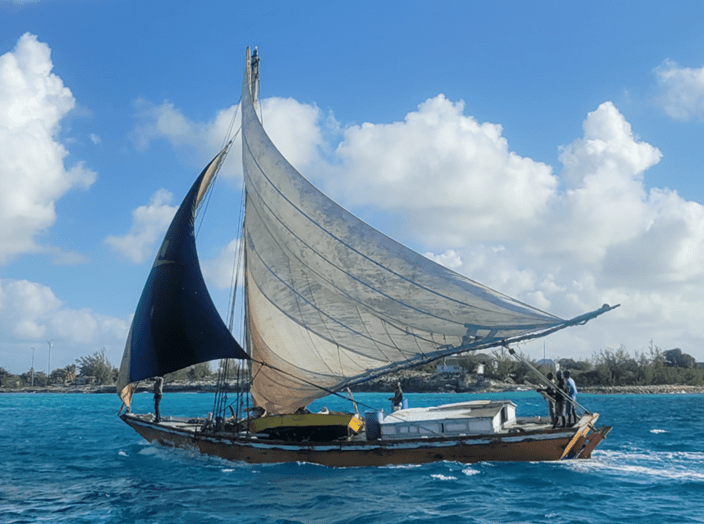
We arrived at the anchorage outside Mathewstown on Great Inagua around 10:30pm on Thursday, the 29th and anchored under sail. It was helpful to have 3 of us onboard for this maneuver since Jeremy was at the helm, I furled the headsail and Brian lowered the anchor manually. Fortunately, the anchor held. Unfortunately, it was a very rolly anchorage since the swell wrapped around the point just south of us and hit us on the beam while the wind had us pointed east. We waited until 8am to try to call the marina and hail someone on channel 16 on the radio but there was no answer. While we waited to hear from everybody, we saw a Haitian sailboat cruise by. Apparently they were delivering concrete blocks. This traditional boat had actual trees for spars and a vast amount of sail area for that size boat. We watched in amazement as they tacked up into port. The boat was so heavy that they could simply drop their sails and rely on momentum to take them in after they dropped their sails following their last tack. This was not an option for our boat since it was very light with high freeboard and a lot of windage so we would have just gotten blown right back.
After trying again at 9AM, we realized that we would have to get on land on our own so we put the dinghy in the water. The outboard was chained to the stern pulpit and the lock was stuck so we had to break a link to get the outboard free. There was a stiff offshore wind so rowing was not an option. We got the dinghy off the deck, got the outboard on, put an anchor and rode in the dinghy along with some paddles and the hand held VHF. Fortunately the 6HP outboard worked well, but it didn’t have enough power to use the dinghy to tow the Beneateau to port due to the strong offshore winds. Brian went ashore in the dinghy and found someone to tow us. The boat that came to tow us was underwhelming. It was a simple boat with an old 15HP outboard. Since the driver had to sit in the back to operate the outboard and the tow rope was tied to a bench towards the back of the boat, the stern sat very low in the water and the driver had to constantly bail water with a bucket while towing. It was just strong enough to tow us so we were grateful for that! First he towed the boat forward while Brian and I pulled up the anchor by hand. Then he towed us to the dock where we tied up.
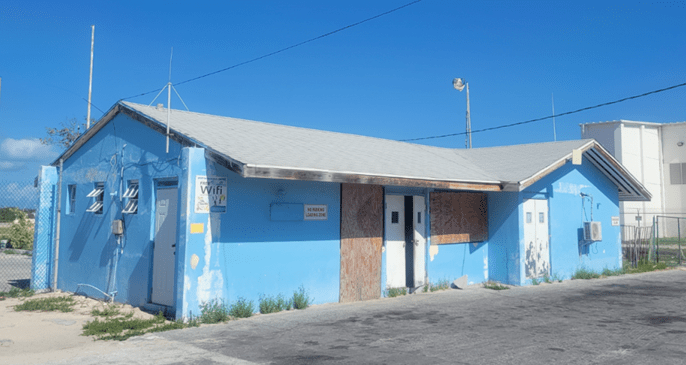
We had been researching options leading up to this. Jeremy had been in contact with the broker via satellite texting and a new starter had been ordered, but first it had to get to the broker in Florida who would have to include some tools (we didn’t have a socket set onboard) and then send it on to Great Inagua. This would not be a speedy process. There’s no 2 day Amazon Prime shipping happening at Great Inagua. The upcoming New Years holiday could add delays for shipping as well. It is only possible to fly out from Great Inagua twice a week: on Friday and Monday. We tied up the dock at 11:30am on Friday the 30th and there was a flight out that afternoon at 1:45PM. I was able to get cleared into the country and on the flight to Nassau. The airport was a very simple setup as you can see from the photo of the building on the right. That building encompassed the arrivals/departures/security, etc. I managed to get a connecting flight back to Miami that evening and a flight home the next day.
I was looking forward to making the whole trip to Florida and crossing the Gulf Stream on a boat for the first time but with the delay in the parts arriving I would have had to use an unknown number of vacation days and I had to get back to work. In the end, I still got the experience of sailing out of a foreign country for the first time, sailing into a foreign country for the first time, my longest continuous passage yet (200 NM), it was the furthest away from land that I had been while on a sailboat, and I got more practice troubleshooting and adapting when things don’t go according to plan. Doing this trip also made me realize just how much I like the Island Packet 380, which Corrie and I bought recently. I like sailing with Jeremy and Brian so I’m sure I’ll make another trip with them in the future.
On the map below, you can see our intended route in lime green, with the detour to Great Inagua in red.
Epilogue – Jeremy and Brian ended up having to wait for parts in Great Inagua for 8 days before resuming the trip and they made it to Florida on January 11th.
 SAILING ISLAND ZEPHYR
Leave a comment